Before focusing on emotional coping strategies for binge eating, it’s essential to first address two root drivers. Not eating enough and being below your body’s natural weight set point. Once those are accounted for, developing a broader toolkit for managing negative emotions becomes the real work. Emotional eating isn’t inherently wrong. After all, food is genuinely comforting. But when it becomes your only response to distress, it can deepen shame and keep the binge cycle going.
Breaking that cycle starts with self-compassion, recognizing that negative moods naturally pass on their own, and gradually building alternative coping skills. These may include breathing exercises, calling a friend, movement, or creative activities. Any activity that creates a pause between the urge and the behavior. Distress is a normal part of life that can’t be eliminated. But with practice and support found in binge eating therapy, it becomes something to move through rather than something to escape.
The two factors most responsible for driving binge eating are not eating enough and being at a weight that is too low for your body. If either one of those two factors is an issue for you, you will want to address those before you focus on other drivers of binge eating. This is because food is a basic need: if you are not eating enough, you will be far more vulnerable to binge eating, especially when experiencing negative emotions.
First, as an experienced eating disorder therapist, I want to reassure you that there is nothing abnormal about this. Food IS comforting—and that’s okay!
However, if you are upset by the eating behaviors in which you engage in response to negative emotions, AND if eating is your ONLY (or an overused) coping skill, you might want to focus on developing some alternative ways of coping with distress.
Every human experiences negative moods. Fear, anger, and sadness all have adaptive functions in ensuring our survival. It is not possible—or even desirable—to eliminate negative feelings.
Some people have great intolerance for negative moods and consequently develop ways of trying to ward off negative feelings.
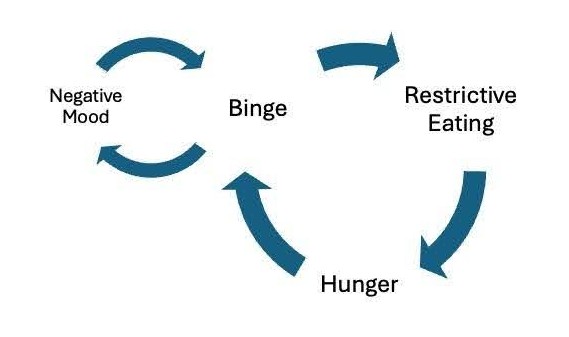
Once a person starts binge eating—which often begins as a response to restriction—and discovers that food soothes them—particularly when they have not eaten enough—a pattern of using food to avoid emotions develops. This makes sense: food has been comforting.
For some people, the coping mechanism of emotional or binge eating creates guilt, shame, and more distress. This may in turn create a secondary feedback loop that serves to maintain the binge cycle. Bingeing drives additional distress, and these people may feel like there is no way out of this cycle.
If the above is the case for you, then your path to conquering binge eating will likely lead you to a point where you must overcome mood intolerance by learning to more effectively manage your negative emotions.
The first step to breaking a binge cycle maintained by negative emotions is to develop self-compassion. Beating yourself up after a binge only keeps you in a state of distress. The antidote is to accept that you did your best in that moment and show yourself the compassion you would show to another person.
Imagine you were trying to comfort someone else who engaged in the same behaviors. Your words would be kinder. Now, turn those words around and say them to yourself.
The next step is to recognize that negative moods generally dissipate over time of their own accord, even if you do nothing in particular. All people must develop skills to cope with negative emotions. Recognize that while eating may provide short-term relief, in the long term it might be deepening the problem, driving guilt, shame, and negative self-esteem.
If you are stuck in a binge cycle, you may want to broaden your repertoire of coping skills. It is helpful both to build up a tolerance to negative emotions and to develop other methods of self-soothing.
First, learn to notice urges for binge eating. Then practice instituting a delay while consciously diverting your behavior towards an alternative, more adaptive coping skill. I tell clients to think of this as building a muscle. The more you practice standing up to urges–and resisting the urge to binge or purge–the stronger and more automatic the new coping skills become.
As an example, if you are feeling guilt after enjoying a delicious restaurant meal and you have thoughts that you’ve “already blown it” and urges to binge, you might try setting a timer for 15 minutes and engaging in a distracting activity such as playing a game or doing a puzzle. Ideally, the activity chosen should be incompatible with the behavior you are trying to prevent— so that if you binge eat on the couch in front of the TV, watching TV would not be a good choice for an alternate behavior.
It may be helpful to learn mindfulness and relaxation skills and also to make a list of alternative activities that are incompatible with bingeing and purging. Examples of activities that help some people cope include doing a relaxation exercise, diaphragmatic breathing, listening to music, calling a friend, cuddling with a pet, taking a walk, doing a craft, coloring, and painting.
Distress is a normal part of life. It is impossible to avoid entirely. Attempts to avoid distress often backfire. Individuals should instead treat distress as data on which they can act, while using coping strategies to manage the discomfort.
And for some, coping with food may be the best option! You’re taking care of yourself in a compassionate way! And there’s nothing wrong with that!
To learn more about ways to conquer binge eating, we invite you to read The Weight Inclusive-CBT Workbook or contact our team at EDTLA directly. We would be honored to walk with you on your road to recovery.
If you’ve tried to manage binge eating on your own and keep finding yourself back in the same cycle, specialized therapy for binge eating disorder can help. You’ll be able to understand what’s really driving it and develop tools to respond differently. Working with an experienced eating disorder therapist means building the self-compassion, emotional resilience, and practical coping skills that make lasting change genuinely possible.
You don’t have to keep navigating the binge cycle alone. And you don’t have to figure out which coping skills work for you through trial and error. Evidence-based therapy provides a structured space to explore the emotional patterns beneath binge eating. You can then develop healthier, more sustainable ways of managing distress. At our Los Angeles eating disorder therapy practice, our compassionate therapists specialize in supporting teens and adults through binge eating disorder recovery with care that meets you exactly where you are. Here’s how to get started:
When binge eating is driven by emotional pain and a lack of effective coping tools, having a therapist who specializes in both the behavioral and emotional sides of recovery can make all the difference in how far and how fast you heal. With dedicated professional support, you can expect to develop a stronger, more compassionate relationship with yourself. Build a genuine toolkit for managing distress. And experience a meaningful reduction in the frequency and emotional weight of binge episodes.
At Eating Disorder Therapy LA, we offer individualized, evidence-based care to clients of all ages and backgrounds. We serve adults, college students, children, teens, and caregivers across the full spectrum of eating disorders and related concerns. Alongside binge eating disorder treatment, we provide specialized therapy for Anorexia Nervosa, Atypical Anorexia, Bulimia Nervosa, Avoidant/Restrictive Food Intake Disorder (ARFID), and Family-Based Treatment (FBT). We also offer support for Excessive Exercise, Body Image challenges, and Phobias Related to Swallowing, Choking, and Vomiting.
To ensure flexible, accessible care that fits your life and schedule, our Los Angeles therapy practice offers both online counseling and group therapy for eating disorders, alongside small group FBT and ARFID consultations, eating disorder education, speaking and training, school programs, and clinical supervision for eating disorder therapists.
For additional tools and insight to support your recovery journey, we invite you to explore our Eating Disorder Blog and Dr. Mulheim’s published books: When Your Teen Has an Eating Disorder and The Weight-Inclusive CBT Workbook for Eating Disorders (available in 2026). To connect with our team directly, call (323) 743-1122 or email Hello@EDTLA.com. We’re here to help you break the cycle with compassion, expertise, and care that goes far beyond willpower.
Dr. Lauren Muhlheim is the founder of Eating Disorder Therapy LA and a licensed psychologist holding the credentials Psy.D., FAED, and CEDS-C. With extensive experience helping clients break the emotional cycles that drive binge eating, she has built her practice around evidence-based, weight-inclusive care that addresses both the behavioral and emotional roots of disordered eating.
Specializing in binge eating disorder, anorexia, bulimia, ARFID, and related concerns across the lifespan, Dr. Muhlheim brings the same compassionate, non-judgmental approach to every client that she writes about in her published books. When Your Teen Has an Eating Disorder and The Weight-Inclusive CBT Workbook for Eating Disorders (available in 2026). As one of the few FBT-certified therapists in Los Angeles, she is licensed in California, Indiana, New York, and Oregon, with a telehealth license in Florida.
TL;DR If food is constantly on your mind and you're struggling to focus on anything…
TL; DR Grief is one of the most powerful threats to eating disorder recovery, and…
TL; DR The holidays can be the first opportunity parents have to notice changes in…
TL;DR The "Freshman 15" is more myth than reality. Research doesn't support that most college…
TL; DR When it comes to sending a young adult with an eating disorder off…
TL;DR "Only eat when you're hungry" is one of diet culture's most deeply ingrained rules,…