Home for the Holidays: Does Your College Student Have an Eating Disorder?

A mother and daughter sitting on a bed, illustrating how parents can spot an eating disorder in a college student home for the holidays.

TL; DR The holidays can be the first opportunity parents have to notice changes in their college student that may signal an eating disorder. Eating disorders often disguise themselves as “healthy habits,” making them easy to miss until they’ve taken a stronger hold. Warning signs include noticeable weight changes, food avoidance or rigidity, increased exercise …


Read more

College Weight Gain: Don’t Fear The Freshman 15!

Two young women joyfully eating pizza with snacks around them, for an article on why not to fear the "freshman 15."

Trying to avoid the “Freshman 15”? Read this first. TL;DR The “Freshman 15” is more myth than reality. Research doesn’t support that most college students gain fifteen pounds, and the fear surrounding it does far more harm than the weight gain itself ever could. What often goes unmentioned is that some weight gain during the …

Read more

Why We Recommend Six Months of Demonstrated Readiness Before College

Two young women and a young man walking on a college campus, for an article on six months of demonstrated readiness before college.

TL; DR When it comes to sending a young adult with an eating disorder off to college, six months of demonstrated recovery is recommended. Summer break simply doesn’t replicate the academic pressure, social dynamics, and independence of college life, making it an unreliable measure of true college readiness. Six months allows enough time for recovery …

Read more

Is Your Young Adult With an Eating Disorder Ready for College?

A group of college students walking, talking, and laughing together, illustrating college readiness after an eating disorder.

First published in October 2015 by Dr. Lauren Muhlheim, Psy.D., CEDS-C, and Katie Grubiak, RDN. Updated October 2026. TL; DR Transitioning to college can be especially challenging for young adults with eating disorders. The stress of new environments, social pressures, and lifestyle changes can exacerbate their struggles. To assess readiness, it’s crucial to evaluate their …

Read more

Managing the College Transition When You’ve Had an Eating Disorder

A woman packs clothes into an open suitcase, for an article on managing the move to college after an eating disorder.

Transitioning to college can be exciting yet challenging, especially for those with a history of eating disorders. It’s crucial to prioritize your recovery during this time. Here are key strategies: Build a Support System: Reach out to family, friends, and potential new connections at college. Keep a list of contacts for support. Follow Your Meal …

Read more

Parent Webinar-Is Your High School Student with an Eating Disorder Ready for College?

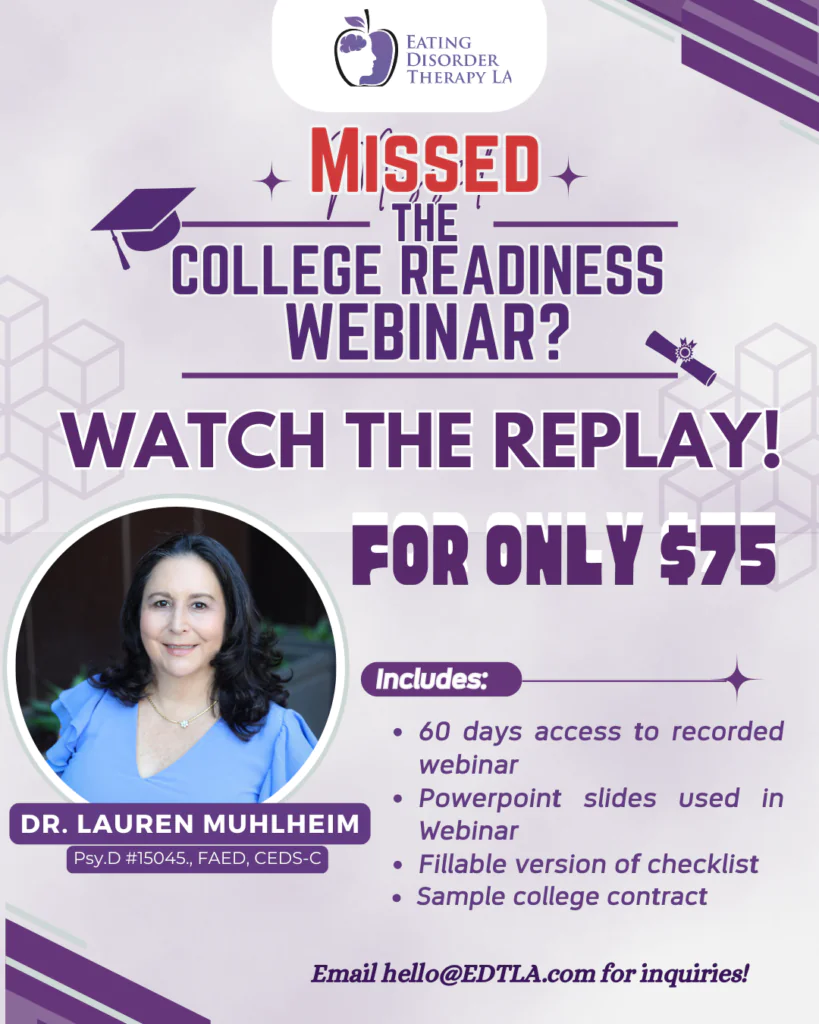
Missed the College Readiness Webinar? Flyer for the webinar replay, available for $75

Dr. Muhlheim gives this webinar once every year in February. Email Hello@EDTLA.com with the subject line “Purchase college readiness” to purchase the recording from 2026 webinar. Are you a parent of a High School Junior or Senior with an eating disorder? Learn how to ensure your student is ready for the transition to college. Attend …

Read more

Eating Disorder College Contracts

A hand signing a contract, illustrating eating disorder college contracts.

What is an eating disorder college contract? And do you need one? If you are sending a young adult with a history of an eating disorder to college (or seminary or another away program), it is a good idea to have a college contract in place. This is our recommendation for young adults with anorexia, …

Read more

On Empowering Parents—Not Pathologizing Them

Feature image for an article on empowering parents, not pathologizing them, in eating disorder treatment.

I often write about the importance of including parents in the treatment of adolescents and young adults. My work is informed by my training in Family-based Treatment (FBT). A central component of this treatment is empowering parents to help their ailing children with eating disorders return to health. When asked why families should be the …

Read more

Skip to content