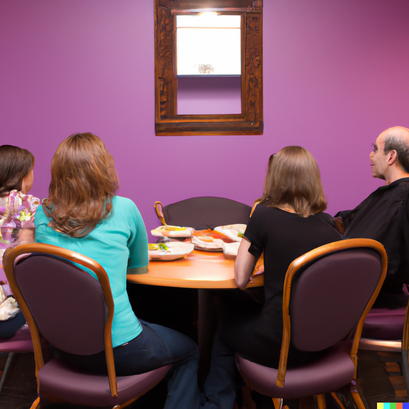
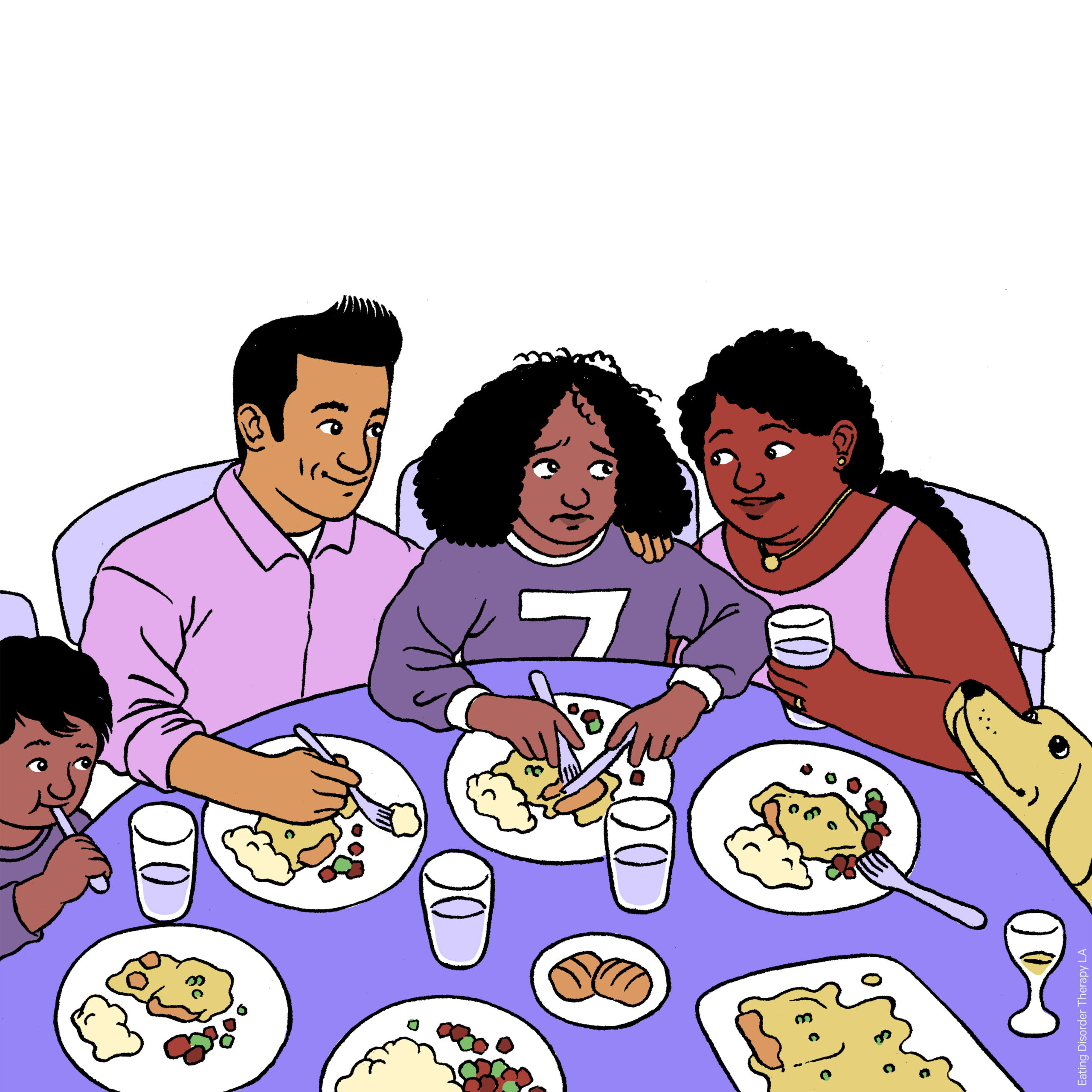
Dall.e
Family-Based Treatment (FBT) is the leading outpatient therapy for adolescent eating disorders, particularly anorexia. A key component is the family meal, where parents actively encourage their teens to eat, often under the observation of a therapist. Research with 21 families revealed that direct prompts (like urging teens to eat specific foods) were more effective than offering choices or information. However, increased parental prompting often led to heightened distress in teens, a natural response as they confront their anorexic tendencies.
Parents should understand that while their efforts might upset their teens, this is part of the recovery process. The focus should be on the amount of food consumed, indicating success, despite potential short-term conflict. Persistence in these challenging interactions is essential for fostering recovery and challenging the eating disorder.
Family-Based Treatment (FBT) is the best-researched outpatient treatment for teen eating disorders, including anorexia. In FBT, the family plays a central role in treatment. Through family meals, parents restore their teens to health and interrupt eating disorder behaviors. In FBT, parents plan, prepare, serve, and supervise meals. Usually, parents are left wondering 1) how to actually get their teens to eat and 2) whether they will harm their teen or the parent-child relationship by requiring them to eat. A 2014 study addressed these concerns by looking at the family meal.
The family meal, an in-office simulation of meals at home, is usually held during the second session. The family is instructed to bring a “picnic” meal for the entire family to the therapist’s office.
The therapist observes the family eating with their teen. The therapist assesses the family’s response to the assignment to renourish their teen and teaches strategies to improve the parents’ effectiveness.
The goal of the session is for the eating disorder therapist to empower the parents to get their teen with anorexia to eat one bite more than the teen was prepared to eat.
Previously, the strategies used by parents to support teens with eating disorders had not been studied. Some posit that teens with eating disorders have regressed in their ability to eat independently and should therefore be viewed as younger children who need more feeding assistance from their parents. Thus, parental strategies to encourage eating incorporate strategies used by parents of younger children with and without feeding problems. These have previously been studied. Parents of younger children use both encouragement and pressure to eat.
The study aimed to discover how teens with anorexia would respond to parents’ attempts to get them to eat. The purpose of this study was to examine the strategies used by parents and the results. The study included 21 families with children between the ages of 12 and 18 receiving FBT for adolescent anorexia.
The main aims of the study were:
While this research was conducted in an artificial setting – a therapist’s office and in the presence of the therapist – the findings should apply to family meals occurring in the home.
Specifically, the researchers found that parents used a variety of strategies to prompt the child to eat:
According to the research, direct, indirect, and physical prompts were more successful in getting adolescents to eat than providing information about the food or offering food-related choices to the adolescent. Thus, while it is tempting to try to reason with your teen about their need to eat food and to try to convince them to eat, such attempts rarely succeed.
The more the parents prompted the teen to eat, and the more successful they were, the more negative the teens became. It makes sense that attempts to encourage eating, which contradicts the anorexic tendencies, would cause psychological distress and a more negative emotional tone. But this is necessary and should be expected.
The authors conclude, “It is interesting that a behavioral focus on eating (i.e., verbal and physical prompting) was associated with parental success as opposed to other strategies such as offering choices to the adolescent or consequences. This indicates that parents’ direct focus on food may be central to eating behavior and supports the emphasis on behavioral change rather than insigh,t which is central to FBT.”
This study highlights the paradox parents face in implementing FBT. When a teen is in distress, the parental instinct is to try to soothe them. Intentionally upsetting the child runs counter to a parent’s nature. However, for teens with anorexia, food is medicine. The best measure of the parents’ success in FBT is the amount of food consumed. Parents should expect that their teen will react negatively to both pressure to eat and the eating itself. This negativity is not a sign of failure, but a reaction to a treatment that is working.
While these interactions often lead to more short-term conflict and distress, parents must persist and weather the storm to support their child’s recovery. Over time, this persistence will challenge the anorexia and encourage change and recovery.
If you’re exploring family-based treatment (FBT), you may be wondering how much direction parents should take—especially during meals. Research consistently shows that clear, confident parental leadership at the family meal can make a meaningful difference in weight restoration and early recovery progress.
You don’t have to guess your way through this process. FBT provides a structured, research-supported framework that helps parents take an active role in nourishing their teen, managing resistance, and supporting medical and emotional stabilization. At Eating Disorder Therapy LA, our Los Angeles–based therapists specialize in FBT for adolescents with anorexia, bulimia, and related eating disorders, guiding families in how to implement effective parental direction during meals and beyond. Taking the next step is simple:
Guiding your teen through meals during eating disorder recovery can feel intimidating, especially when resistance or anxiety is high. Family-based treatment (FBT) equips parents with clear, research-informed strategies to take effective leadership at meals, support weight restoration, and help their teen move toward sustained physical and emotional recovery.
At Eating Disorder Therapy LA, we provide comprehensive, evidence-based care for individuals and families across all stages of life, including children and teens, college students, adults, and caregivers. Our clinicians are trained to treat the full spectrum of eating disorders and related challenges. In addition to FBT, we offer specialized therapy for Anorexia Nervosa, Atypical Anorexia, Bulimia Nervosa, Avoidant/Restrictive Food Intake Disorder (ARFID), and Binge Eating Disorder. We also support concerns such as excessive exercise, body image distress, and phobias related to swallowing, choking, or vomiting.
To ensure accessible and flexible treatment, our Los Angeles-based practice offers both virtual therapy and eating disorder group therapy options. We also provide small group FBT and ARFID consultations, professional speaking, training and educational programs, school-based services, and clinical supervision for therapists seeking advanced expertise in family-centered eating disorder care.
For continued learning and support, we invite you to explore our eating disorder blog and Dr. Muhlheim’s books, When Your Teen Has an Eating Disorder and The Weight-Inclusive CBT Workbook for Eating Disorders (available in 2026). To connect with our team, please call (323) 743-1122 or email Hello@EDTLA.com. We look forward to helping families lead recovery with confidence and clarity.
Dr. Lauren Muhlheim, Psy.D., FAED, CEDS-C, is the founder of Eating Disorder Therapy LA and a licensed psychologist with extensive experience delivering evidence-based treatment for eating disorders across the lifespan. Her clinical expertise centers on family-based treatment (FBT), an approach that empowers parents to take a leading role in restoring nutrition, guiding recovery at home, and supporting adolescents as they return to healthy development. She treats anorexia, bulimia, binge eating disorder, ARFID, and related conditions, and is one of the few FBT-certified therapists in Los Angeles. Dr. Muhlheim is the author of When Your Teen Has an Eating Disorder and The Weight-Inclusive CBT Workbook for Eating Disorders, and she developed one of the only FBT training programs for dietitians. Licensed in California, Indiana, New York, and Oregon, with a Florida telehealth license, she is widely recognized for her leadership in family-centered, weight-inclusive eating disorder care.
White, H.J., Haycraft, E., Madden, S., Rhodes, P., Miskovic-Wheatley, J., Wallis, A., Kohn, M., and Meyer, C. (2015). How do parents of adolescent patients with anorexia nervosa interact with their child at mealtimes? A study of parental strategies used in the family meal session of family-based treatment. Int. J. Eat. Disord., 48: 72-80.
Weight loss is probably on your mind these days. GLP-1 medications—Ozempic, Wegovy, Zepbound—have made it…
A few weeks ago, I got an email from a representative of Rula, an online…
TL;DR If food is constantly on your mind and you're struggling to focus on anything…
TL; DR Before focusing on emotional coping strategies for binge eating, it's essential to first…
TL; DR Grief is one of the most powerful threats to eating disorder recovery, and…
TL; DR The holidays can be the first opportunity parents have to notice changes in…