Is the (Eating Disorder) Treatment Your Child is Getting FBT? A Therapist Explains

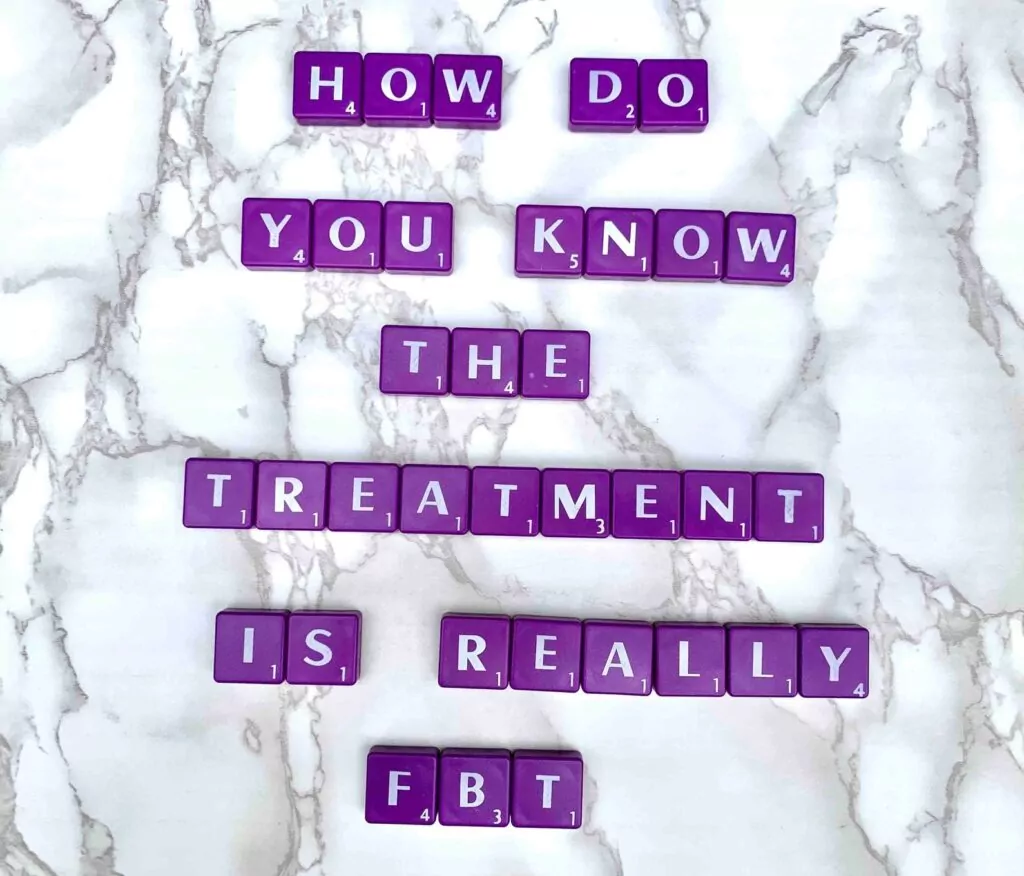
Purple scrabble tiles spelling 'How you you know the treatment is really FBT?' Meeting with an experience FBT therapist in Los Angeles, CA, can help you determine that type of treatment your received (and needs).

TL;DR Family-Based Treatment (FBT) is a specialized, evidence-based therapy for children and teens with eating disorders, developed in the 1970s and 1980s. It’s important for parents to differentiate true FBT from general family therapy or other approaches, as not all treatments that claim to be FBT are fully compliant with its structured methodology. Key indicators …

Read more

Early Intervention with Family-Based Treatment (FBT) for Eating Disorders

A teen girl sits next to a doctor who is writing notes. Does your teen show early signs of an eating disorder? Get equipped with the right guidance from a n FBT therapist in Los Angeles, CA.

TL;DR Early intervention is crucial in addressing eating disorders, which can lead to severe health issues if not treated promptly. Family-Based Treatment (FBT) is a leading, evidence-based approach tailored for teens, emphasizing parental involvement to support recovery. Despite its potential benefits, parents often hesitate to intervene due to uncertainty about the early signs of these …

Read more

Expert Guidance: When to Add an Individual Therapist in FBT-Phase 1

Picture of a teen in an individual therapy session. Is an individual therapist during FBT necessary? An expert family-based treatment therapist in Los Angeles, CA, explains why it might not be a great idea.

TL;DR In Family-Based Treatment (FBT) for teen eating disorders, experts discourage adding an individual therapist during Phase 1 (nutritional rehabilitation). Most teens do not require individual therapy at this stage, as it can undermine the family’s role and the focus on nutritional restoration. Experts agree that individual therapy should only be considered if there are …

Read more

Are We Setting Recovery Weights Too Low? Insight From an FBT Therapist

Photo of a rusty doctor scale. Setting the right goal weight in eating disorder recovery can feel intimidating, but an experienced FBT therapist can help. Discover the tools you need for healthy success through Family-Based Treatment in Los Angeles, CA.

TL;DR At the 2018 International Conference on Eating Disorders, experts discussed the low BMI threshold (18.5) often used to define recovery from anorexia nervosa, suggesting it’s inadequate for many individuals, especially those with higher weights or atypical anorexia. Many parents and practitioners advocate for a more individualized approach to recovery weights, emphasizing that a higher …

Read more

How We Set Recovery Weights and Why It Matters for Long-Term Healing

Drawing of a doctor weighing a teen patient. Are you wondering how we set recovery weights in eating disorder recovery? Learn how Family-based Treatment in Los Angeles, CA, prioritizes health and long-term success for teens and adults.

TL;DR Weight gain is a vital part of recovery from eating disorders for individuals of all sizes, including those with Atypical Anorexia and bulimia. However, there’s a lack of consensus on how to set appropriate recovery weights. Research shows that complete weight restoration is often essential for psychological recovery, as it helps alleviate eating disorder …

Read more

Maintaining Recovery During Short Lunch Times

Eating Lunch in Recovery [Image description: Neon Light spelling "EAT"] Depicts the instruction for a person in eating disorder recovery to eat lunch.

Guest post by 2024-2025 doctoral extern, Natalie Cynamon.  School lunchtime is ideal for catching up with friends, decompressing, or watching a show on your phone. However, it’s not long until the bell rings again, telling you it is time to return to class. With so little time to do what you want, it can be …

Read more

How Much Food to Feed?

Family having dinner and unhappy in FBT [Image description: family of 2 adults and two kids and the teen girl looks very unhappy about eating] Represents a potential family in California doing FBT for their teen's eating disorder

In Family-Based Treatment (FBT), we charge families with nourishing their teens back to health through meals at home. Because FBT is a parent empowerment model, parents are often given little specific guidance about how to do this. If you are like other families with whom I’ve worked, now that you understand this important point, you …

Read more

Should You Let Your Teen Become a Vegetarian?

Should you let your teen become vegetarian [Image description: purple scrabble tiles spelling "vegetarian" above a plate with raw vegetables]

By Katie Grubiak, RDN, and Lauren Muhlheim, Psy.D. We acknowledge that vegetarianism can offer benefits for both individuals and the environment. We also recognize that vegetarianism is embedded in some cultures and religions, and most children and teens raised in these cultures thrive. This article does not aim to debate the ethics of vegetarianism. Instead, …

Read more

Return to Exercise and Eating Disorder Recovery in Teens During FBT

Return to exercising during FBT for teen eating disorders [Image description: drawing of a teen running on a treadmill] Represents a potential teen undergoing FBT for an eating disorder in Los Angeles, California

Excessive exercise is often a component of various eating disorders, including anorexia nervosa, bulimia nervosa, atypical anorexia, OSFED, and subclinical eating disorders. It is a symptom that affects up to 80% of those with an eating disorder (Quesnel et al., 2023). By expending energy, exercise may contribute to the negative energy balance that may trigger …

Read more

ARFID in Children

Therapy for ARFID in Children in California [Image description: a boy eating breakfast of cereal and juice and looking unhappy] Represents a potential client receiving counseling for ARFID in California

Does My Child Have Avoidant/Restrictive Food Intake Disorder (ARFID)? For the most part, kids are pickier eaters than adults. If your child is a “picky eater” you may be wondering whether their eating is normal or not. You may have heard about Avoidant Restrictive Food Intake Disorder (ARFID) and wonder whether your child might have …

Read more

Skip to content