Family-Based Treatment (FBT) is a specialized, evidence-based therapy for children and teens with eating disorders, developed in the 1970s and 1980s. It’s important for parents to differentiate true FBT from general family therapy or other approaches, as not all treatments that claim to be FBT are fully compliant with its structured methodology.
Key indicators that your child received genuine FBT include:
The therapist is trained in FBT and familiar with its principles and phases.
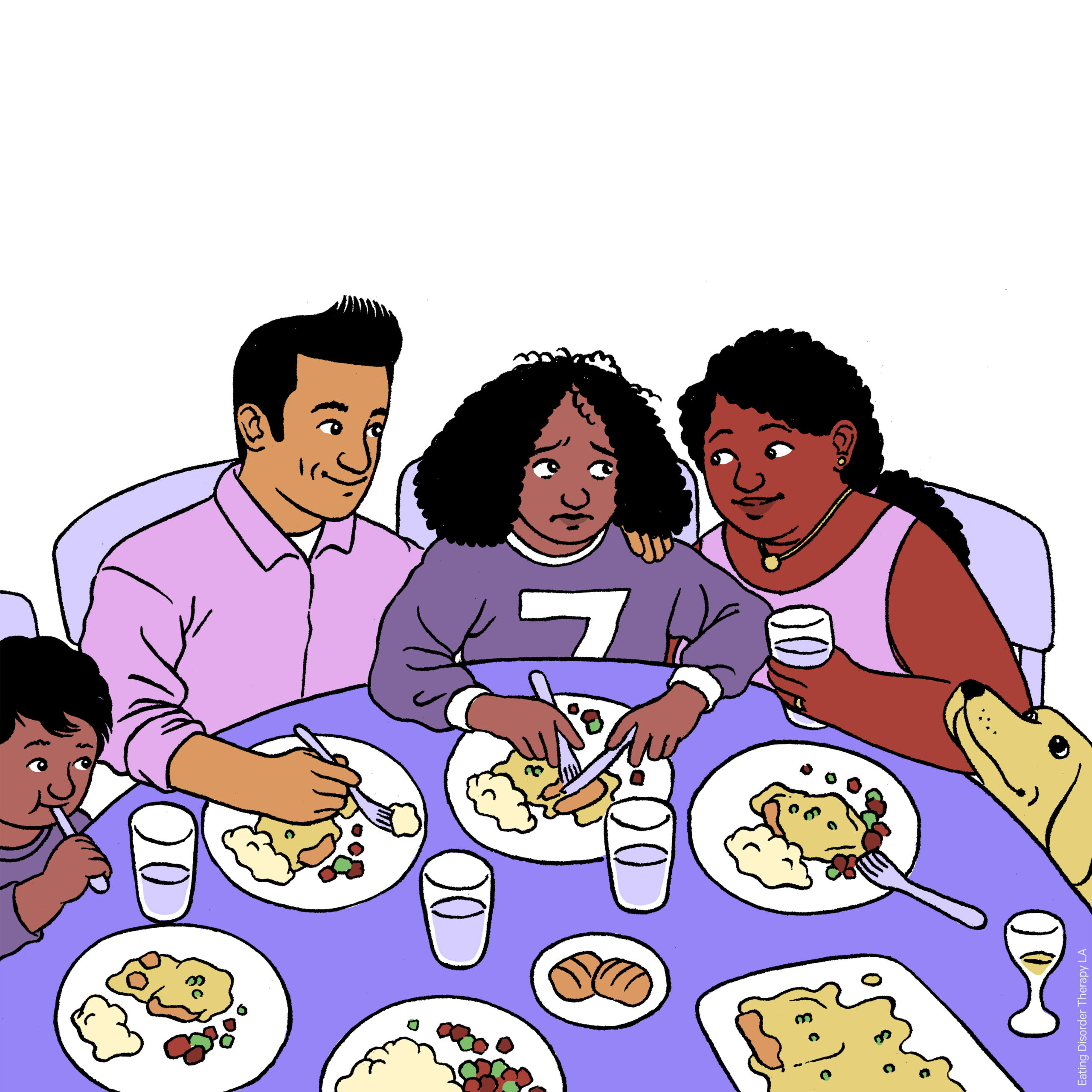
Parents are actively involved in meal supervision and restoring nutritional health.
The focus is on the child’s recovery, with minimal therapist time spent alone with the teen.
Conversely, signs that the treatment may not have been true FBT include:
Parents being blamed for the eating disorder.
The therapist spending most sessions with the teen alone.
Lack of parental involvement in meal supervision.
If you’re unsure about the treatment your child received, consult with a qualified FBT therapist to ensure they get the right support.
When I speak to new families about Family-Based Treatment (FBT), I often find that they are confused about what it is and what it isn’t.
Family-Based Treatment (FBT) is a type of evidence-based treatment for child and teen eating disorders. This treatment was developed at the Maudsley Hospital in London in the 1970s and 1980s. Doctors Lock and Le Grange manualized it into its current form in 2001. Because of its name, FBT is often confused with the more general “family therapy.” Be careful, because these are not the same thing. While both involve the family, FBT is a very specific, behaviorally-focused therapy.
While a treatment that includes some elements of FBT—but falls short of the full manualized treatment—may work for some people with eating
We don’t yet know which elements of FBT are critical to its efficacy and make it such a successful treatment. This would take expensive dismantling studies in which different partial treatments are tested against each other. Except for studies documenting a separated FBT (where only the parents attend sessions), no such study has been cited in the literature. Until we have good evidence that suggests otherwise, treatments that stay true to the original, already-tested treatments are the safest bet.
I once worked with a patient with panic disorder who had had previous treatment. He told me that his previous therapist had conducted cognitive-behavioral therapy (CBT), widely accepted as the best evidence-based treatment for panic disorder. When I dug deeper, I found that his therapy had included no exposure to the sensations of panic, considered to be the core element of CBT treatment for panic disorder. Instead, the treatment had focused on discussing his anxiety thoughts—a very different protocol. From this experience, I learned to inquire carefully about the treatment my patients have previously received before accepting that it cannot work for them.
So it is with Family-Based Treatment. Sometimes parents tell me that they think they tried FBT, but are not sure. If your child was treated in an academic center, it’s more likely they got the evidence-based treatment of FBT in its full form. However, some parents who tell me that FBT didn’t work also tell me:
In each of these situations, it is obvious to me that the treatment is not what I would consider FBT. It is true that including some aspects of FBT or even a “watered-down” FBT may be better than no FBT or parent inclusion at all. However, it’s important to know whether your child had the real thing or not, especially if they end up needing more or different treatment.
Often, parents who tell me they struggled with renourishing a child on their own find that things go much better once they start working with me or another FBT-trained therapist. That’s not to say that parents should never try to renourish a teen on their own. Just that supporting a child with an eating disorder is extremely hard work and best done with the support and guidance of a professional at their side.
Accordingly, I created the checklists below. Parents may use it to determine whether the treatment their child received (or is receiving) is really FBT. To how many of the following statements can you answer “YES” (the more the better)?
Our therapist received training through the Training Institute for Child and Adolescent Eating Disorders.
Below are some indicators that your child might not have “gotten FBT” and might be receiving some conflicting messages:
I have been told that we, the parents, had caused the eating disorder.
In conclusion, FBT has been proven to be the most effective treatment for teens with eating disorders in clinical trials. That said, not every treatment works for everyone. In my opinion, it is best to start with something that has a backing. If that doesn’t work, you might then try something else. When you have sought out an evidence-based treatment, it’s important to make sure you’re getting the treatment in its researched form.
At EDTLA, we provide FBT–the real thing–to teens in Los Angeles (and online throughout California). We can also recommend dietitians and medical doctors to add to your treatment team.
When your child is in eating disorder treatment, it can be hard to know whether the approach being used truly follows Family-Based Treatment (FBT). Or if key elements are missing. FBT is a well-established, evidence-based model. It actively involves parents in restoring nutrition, supporting weight recovery, and guiding healing at home.
You don’t have to sort this out on your own. With proper FBT, families receive clear structure, education, and professional guidance. That way, caregivers can take an active role in recovery rather than being sidelined. At Eating Disorder Therapy LA, we specialize in delivering authentic FBT for adolescents with anorexia, bulimia, and related eating disorders. If you’re questioning whether your child’s current care aligns with FBT principles, getting support is simple:
When a child is in eating disorder treatment, families often wonder whether the care they’re receiving truly follows Family-Based Treatment. With the right implementation of FBT, caregivers are actively involved in restoring nutrition, supporting medical stability, and helping their child move toward full, lasting recovery. At Eating Disorder Therapy LA, we provide evidence-based treatment for individuals and families across all stages of life, including adults, college students, children, teens, and caregivers. Our clinicians are trained to treat the full spectrum of eating disorders and related concerns. In addition to FBT, we offer specialized therapy for Anorexia Nervosa, Atypical Anorexia, Bulimia Nervosa, Avoidant/Restrictive Food Intake Disorder, and Binge Eating Disorder, along with support for challenges such as Excessive Exercise, Body Image Distress, and Phobias Related to Swallowing, Choking, and Vomiting.
To ensure families have access to appropriate and flexible care, our Los Angeles-based practice offers both Online Counseling and Group Therapy for eating disorders. We also provide Small Group FBT consultations, ARFID Consultations for Therapists, Eating Disorder Speaking, Training, and Education, School Programs, and Clinical Supervision for Therapists.
For continued education and guidance, we invite you to explore our Eating Disorder Blog and Dr. Muhlheim’s books, When Your Teen Has an Eating Disorder and The Weight-Inclusive CBT Workbook for Eating Disorders (available in 2026). To speak with our team directly, call (323) 743-1122 or email Hello@EDTLA.com. We look forward to supporting families in accessing true, evidence-based FBT care.
Dr. Lauren Muhlheim, Psy.D., FAED, CEDS-C, is the founder of Eating Disorder Therapy LA and a licensed psychologist with extensive experience providing evidence-based treatment for eating disorders across the lifespan. Her clinical work focuses on anorexia, bulimia, binge eating disorder, ARFID, and related concerns, with particular expertise in family-based treatment (FBT) for adolescents. As one of the few FBT-certified therapists in Los Angeles, Dr. Muhlheim helps parents take an active, informed role in nutrition restoration, recovery at home, and supporting healthy adolescent development. She is the author of When Your Teen Has an Eating Disorder and The Weight-Inclusive CBT Workbook for Eating Disorders, and has developed one of the only FBT training courses for dietitians. Licensed in California, Indiana, New York, and Oregon, with a Florida telehealth license, Dr. Muhlheim is widely recognized for her leadership in family-centered, weight-inclusive eating disorder care.
TL;DR If food is constantly on your mind and you're struggling to focus on anything…
TL; DR Before focusing on emotional coping strategies for binge eating, it's essential to first…
TL; DR Grief is one of the most powerful threats to eating disorder recovery, and…
TL; DR The holidays can be the first opportunity parents have to notice changes in…
TL;DR The "Freshman 15" is more myth than reality. Research doesn't support that most college…
TL; DR When it comes to sending a young adult with an eating disorder off…