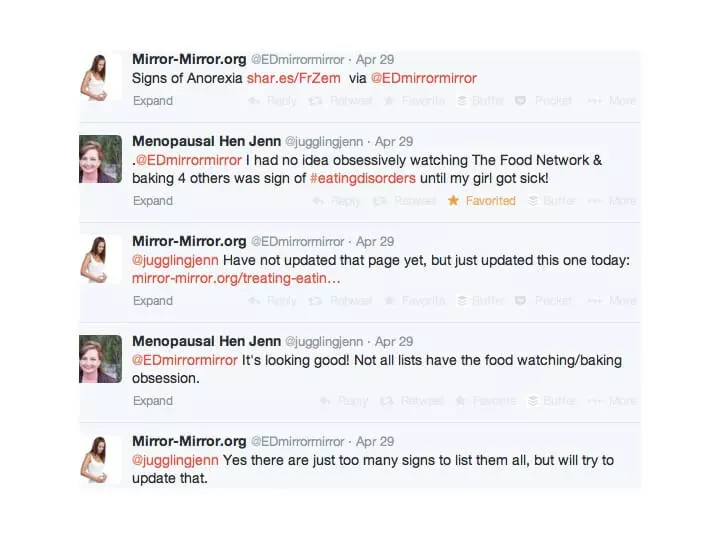
This interaction on twitter caught my eye:
Watching cooking shows, collecting and reading recipes, and cooking for others (but not eating it oneself) are some of the earliest signs of anorexia that are often missed and misinterpreted by parents.
In Keys’ landmark study “The Biology of Human Starvation” male volunteers were put on starvation diets. According to Keys, food became “the principal topic of conversation, reading, and daydreams.” The volunteers studied cookbooks and collected cooking utensils. Three of them went on to become cooks even though they’d had no interest in cooking before the experiment. When starving, people may obtain vicarious satisfaction from cooking and watching others eat.
In my own experience, I contracted severe food poisoning during my second pregnancy. Unable to eat without severe consequences, my doctors instructed me to forgo solid food for a full week. I remember clearly that I spent the week lying in bed (entertaining my toddler) and watching cooking shows. It seemed nonsensical to me at the time, like an unusual form of self-torture. But, now I know it was an attempt to vicariously soothe my intense hunger.
In her book Brave Girl Eating, Harriet Brown discusses how her daughter went through a “foodie” phase during the onset of her anorexia. I have seen a similar profile in a number of my young clients. Parents do not usually think these are signs of trouble and are more often impressed by their child’s sophistication. Some of the less obvious early signs of starvation parents should watch for include:
Of course, not every child who shows a strong interest in cooking has or will develop anorexia, but it is something that should pique a parents’ interest.
My own daughter went through a phase where she was obsessed with cooking and watching cooking shows. It so happened that she was not eating enough at this time, which coincided with the start of her adolescent growth spurt. I did an early FBT-like intervention and she gained and grew; as she did, the obsession with cooking abated. Was this merely a passing phase or anorexia averted? I’ll never know, but I’m glad I intervened. (More about that in future post.)
When a child with a diagnosis of anorexia shows these behaviors, I recommend that they be stopped. In FBT, parents take charge of their child’s food and food environment. Food is the child’s medicine and the number one priority. For this reason, vicarious gratification of hunger should be removed. Children with anorexia should not be watching cooking shows, reading recipes, or cooking. I usually recommend that children do not participate in preparing their own food at all in Phase 1. In Phase 2, children gradually get involved in food preparation again, but the usual rule I recommend is that if they make something, they must eat it.
A few weeks ago, I got an email from a representative of Rula, an online…
TL;DR If food is constantly on your mind and you're struggling to focus on anything…
TL; DR Before focusing on emotional coping strategies for binge eating, it's essential to first…
TL; DR Grief is one of the most powerful threats to eating disorder recovery, and…
TL; DR The holidays can be the first opportunity parents have to notice changes in…
TL;DR The "Freshman 15" is more myth than reality. Research doesn't support that most college…