How Do I Parent My Teen During Family-Based Treatment? When to Set Limits

One teen pushing another in a shopping cart, illustrating when parents should set limits during Family-Based Treatment (FBT).

TL;DR Parenting a teen with an eating disorder during Family-Based Treatment (FBT) is challenging. Parents need to balance normal parenting with the unique demands of recovery, which often involves refeeding at home. It’s important to distinguish between behaviors stemming from the eating disorder (like defiance during meals) and typical teenage rebellion. During high-stress moments related …


Read more

Managing the College Transition When You’ve Had an Eating Disorder

A woman packs clothes into an open suitcase, for an article on managing the move to college after an eating disorder.

Transitioning to college can be exciting yet challenging, especially for those with a history of eating disorders. It’s crucial to prioritize your recovery during this time. Here are key strategies: Build a Support System: Reach out to family, friends, and potential new connections at college. Keep a list of contacts for support. Follow Your Meal …

Read more

Are We Setting Recovery Weights Too Low? Insight From an FBT Therapist

A rusty doctor's scale, for an FBT therapist's article on recovery weights that are set too low.

TL;DR At the 2018 International Conference on Eating Disorders, experts discussed the low BMI threshold (18.5) often used to define recovery from anorexia nervosa, suggesting it’s inadequate for many individuals, especially those with higher weights or atypical anorexia. Many parents and practitioners advocate for a more individualized approach to recovery weights, emphasizing that a higher …

Read more

Impact on Eating When You Have a Specific Fear of Vomiting (Emetophobia)

Purple scrabble tiles spelling out "emetophobia" & "vomit."

By Carly Poynter, Psy.D. and Lauren Muhlheim, Psy.D. Emetophobia is an intense fear of vomiting. It can include fear of throwing up yourself, fear of seeing someone else get sick, and fear of feeling nauseous. For many people, it quietly shrinks what, where, and how much they eat. If you have been diagnosed with a …

Read more

Maintaining Recovery During Short Lunch Times

A neon sign spelling "EAT," a reminder to keep eating lunch in eating disorder recovery even when lunch breaks are short.

Guest post by 2024-2025 doctoral extern, Natalie Cynamon.  School lunchtime is ideal for catching up with friends, decompressing, or watching a show on your phone. However, it’s not long until the bell rings again, telling you it is time to return to class. With so little time to do what you want, it can be …

Read more

ARFID and Holidays: Strategies for Managing Eating Challenges

Purple Scrabble tiles spelling "ARFID and Holidays" for an article on managing ARFID eating challenges at holiday meals.

The holidays are supposed to be joyous occasions where families gather and eat together. But these two particular elements combined—family and food—can be extremely challenging for adults with Avoidant Restrictive Food Intake Disorder (ARFID). If you are an adult who has ARFID you may struggle with eating enough overall and or with variety. You may …

Read more

Private Equity and Eating Disorders: What You Need to Know

An empty boardroom with windows, illustrating private equity firms buying into eating disorder treatment centers.

In case you haven’t been paying attention, the economics of eating disorder treatment centers have been evolving. And it is doing so in ways that may be harmful. Today, a very small number of large entities own and run most of the country’s residential treatment and day treatment centers. Private equity firms now back most …

Read more

Eating Disorders Before and After Bariatric Surgery–What You Need to Know

Purple Scrabble tiles spelling "Eating Disorders and Bariatric Surgery" for a guide to eating concerns around weight-loss surgery.

Health professionals often recommend bariatric surgery for patients with larger bodies. A large body size, referred to in the medical world as “obesity,”—a term we will not use unless citing medical data— is not the same as an eating disorder. Yet, there is an intersection. A considerable number of people considering bariatric surgery may have …

Read more

Dr. Muhlheim’s Spring 2024 Training and Speaking Engagements

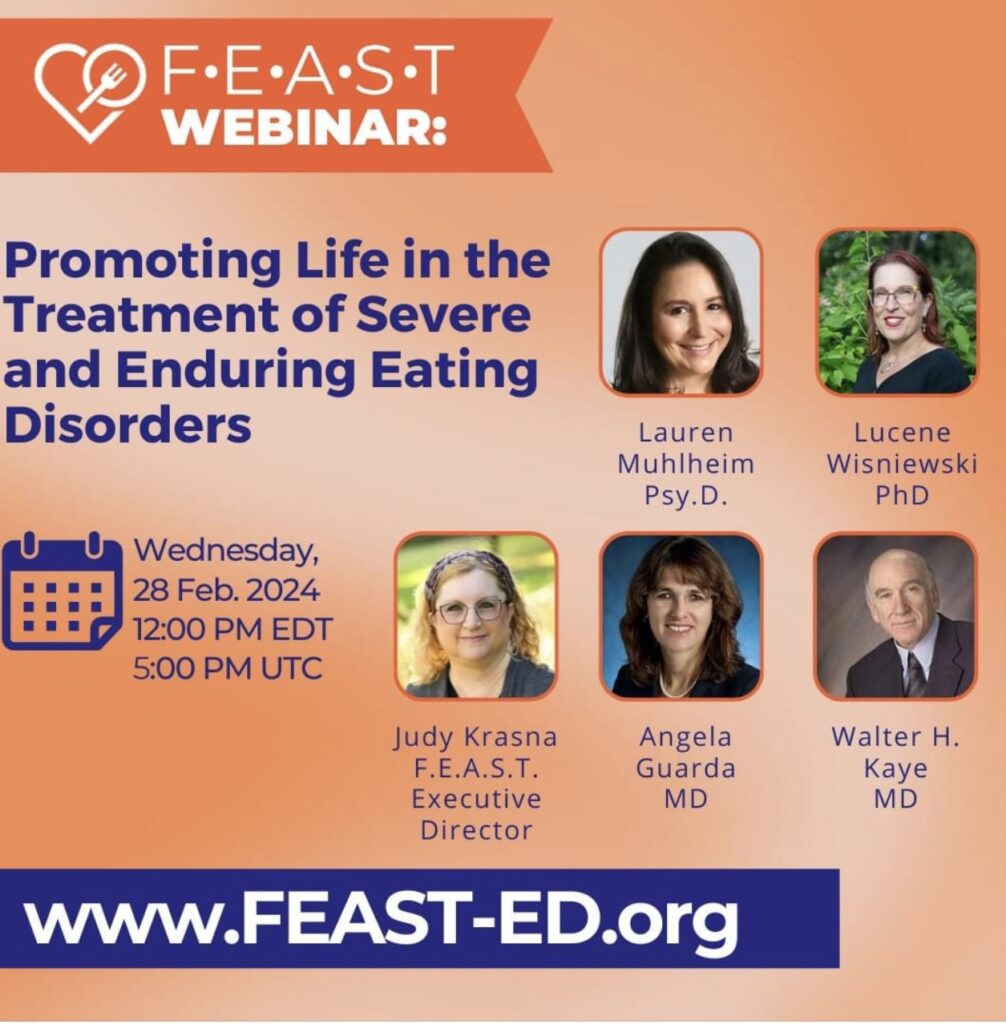
Flyer for the FEAST webinar "Promoting Life in the Treatment of Severe and Enduring Eating Disorders," featuring Dr. Muhlheim, Feb. 28, 2024.

Dr. Muhlheim is busy with several speaking and training engagements this spring. See where you can catch her below. On February 4, she’ll be a speaker at the 2024 Families Empowered and Supporting Treatment of Eating Disorders (FEAST) of Knowledge. Her topic is Stages of Recovery: Setting Parental Expectations. Registration is available through FEAST’s website. …

Read more

Group Therapy for Eating Disorders

Purple scrabble tiles spelling "Eating Disorder Group Therapy"

What is Group Therapy? Group therapy is when several patients are treated together in the same room—or as is often the case today, the same zoom meeting—as other patients with the same problem, usually with one or two leaders or therapists. Group Therapy can be helpful for people with eating disorders and their supportive loved …

Read more

Skip to content