Unintentional Weight Loss as a Trigger for Anorexia.

Contrary to popular belief, weight loss leading to anorexia nervosa (AN) does always start intentionally and may follow an illness. Some of the biggest misunderstandings about anorexia nervosa center around it being an intentional illness and related to vanity. Paper on Unintentional Onset of Anorexia A paper by Brandenburg and Andersen in 2007 entitled Unintentional …

Read more

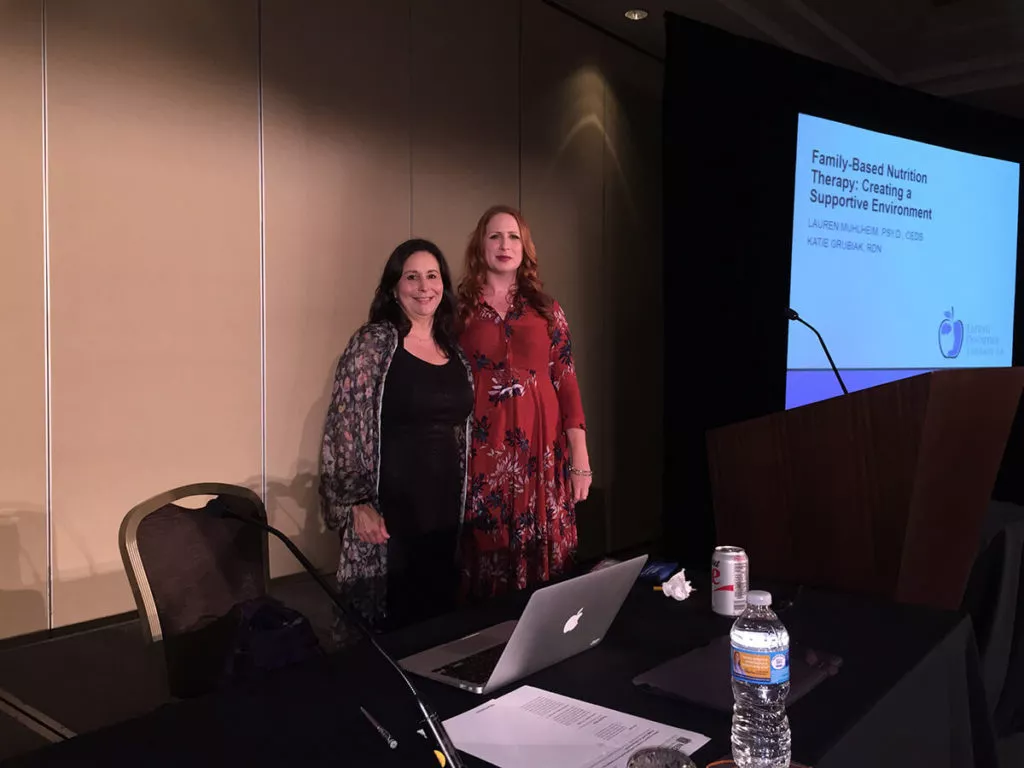
Presentation at NEDA 2015 conference

Lauren Muhlheim and Katie Grubiak presenting at the NEDA 2015 conference.

Katie and I had the honor of presenting in the Individual, Family, and Friends track at the National Eating Disorder Association Conference in San Diego yesterday.  The title of our talk was:  Family Based Nutrition Therapy:  Creating A Supportive Environment.  It was a chance to share the way we work to support families who are …

Read more

Interested in Weight Loss? We CAN’T Help You. Here’s Why

A larger Black woman chooses fruit at a grocery store, illustrating how to set up your environment to support eating disorder recovery.

Learn More About Our Non-Diet Approach At Eating Disorder Therapy LA, we treat eating disorders (including Anorexia Nervosa, Bulimia Nervosa, Binge Eating Disorder, and Other Specified Feeding and Eating Disorder or OSFED) across the weight spectrum. We often get inquiries from clients interested in help for binge eating or emotional eating, with their primary goal …

Read more

The Hidden Benefits of Full Fat Dairy

A glass of milk with cookies, illustrating the hidden benefits of full-fat dairy in eating disorder recovery.

by Katie Grubiak, RDN Read our new post about the importance of including dairy in eating disorder recovery. History of the Low-Fat Dairy Movement Since the 1980s, physicians, the federal government, the food industry, and popular media have championed the low-fat approach to dieting and weight control. The idea stemmed from a few studies published …

Read more

Deliciousness! by Katie Grubiak, RD

Collage of three photos of different dogs, for Katie Grubiak's post on deliciousness and enjoying food.

Deliciousness! Yes, that is what this pup Moose is expressing in this photo.  It is deliciousness that we seek in food and in life, isn’t it? Well maybe we forgot one or both of these pursuits along the way. Consuming delicious food, selected by our taste buds in our weight-shaming thin-obsessed society is sometimes associated …

Read more

Eating Disorders in the Orthodox Jewish Community

Two loaves of challah under an embroidered cover, for an article on eating disorders in the Orthodox Jewish community.

Having worked with several Orthodox clients and also having participated in a Chabad Orthodox congregation when my family lived in Shanghai, I was excited to join in on the Academy for Eating Disorders’ Tweetchat on Eating Disorders in the Orthodox Community last month. The chat was informative and the full transcript of the chat is …

Read more

FBT Insights from the Neonatal Kitten Nursery

A kitten, for an article on lessons for Family-Based Treatment (FBT) from a neonatal kitten nursery.

I recently began volunteering at the Best Friends Neonatal Kitten Nursery. Best Friends Los Angeles opened its neonatal kitten nursery in February 2013.  The nursery is staffed with a dedicated coordinator and supported by volunteers who sign up for two hour feeding shifts 24 hours a day to help the kittens grow and thrive. If …

Read more

Look before you leap: Binge Eating Disorder, Vyvanse, and Evidence-Based Psychotherapies

Drawing of 2 pills outside of a prescription pill bottle

Learn Why Therapy is Superior to Medication for The Treatment of Binge Eating Disorder by Elisha M. Carcieri, Ph.D., Psychologist, and staff therapist Binge eating disorder (BED) made headlines when the FDA approved lisdexamfetamine dimesylate (Vyvanse) for the treatment of BED. So, what is BED, how is it treated, and what does this treatment option mean …

Read more

Ten Facts About Weight Stigma – Guest post by Liliana Almeida, Ph.D.

A larger Black woman holding a towel that reads "wide load," for a guest post on ten facts about weight stigma.

  Weight stigma is a bias or discrimination relating directly to weight. Despite the fact that more than half of U.S. citizens are larger-bodied, our society holds a strong negative bias against fatness. The media reinforces weight stigma. The media, such as news media, displays persons in larger bodies in stigmatizing ways by depicting them …

Read more

Skip to content